An Exception was encountered at ‘In [12]’.
Image classification with Randomized Sparse Mixed Scale Autoencoders, regularized by the availability of image labels
Authors: Eric Roberts and Petrus Zwart
E-mail: PHZwart@lbl.gov, EJRoberts@lbl.gov
This notebook highlights some basic functionality with the dlsia package.
In this notebook we setup autoencoders, with the goal to explore the latent space it generates. In this case however, we will guide the formation of the latent space by including labels to specific images.
The autoencoders we use are based on randomly construct convolutional neural networks in which we can control the number of parameters it contains. This type of control can be beneficial when the amount of data on which one can train a network is not very voluminous, as it allows for better handles on overfitting.
The constructed latent space can be used for unsupervised and supervised exploration methods. In our limited experience, the classifiers that are trained come out of the data are reasonable, but can be improved upon using classic classification methods, as shown further.
[1]:
import numpy as np

import torch
import torch.nn as nn
import torch.optim as optim

from dlsia.core import helpers
from dlsia.core import train_scripts
from dlsia.core.networks import baggins
from dlsia.core.networks import sparsenet
from dlsia.test_data.two_d import random_shapes
from dlsia.core.utils import latent_space_viewer
from dlsia.viz_tools import plots
from dlsia.viz_tools import plot_autoencoder_image_classification as paic


import matplotlib.pyplot as plt
import matplotlib
from torch.utils.data import DataLoader, TensorDataset
import einops
import umap
Create data
Using our dlsia in-house data generator, we produce a number of noisy “shapes” images consisting of single triangles, rectangles, circles, and donuts/annuli, each assigned a different class. In addition to augmenting with random orientations and sizes, each raw, ground truth image will be bundled with its corresponding noisy and binary mask.
Parameters to toggle:
n_train : number of ground truth/noisy/label image bundles to generate for training
n_labeled : number of images with labels
n_test : number of ground truth/noisy/label image bundles to generate for testing
noise_level : per-pixel noise drawn from a continuous uniform distribution (cut-off above at 1)
nxy : size of individual images
[2]:
n_train = 300
n_labeled = 200

n_test  = 400
noise_level = 0.50
nxy = 32

train_data = random_shapes.build_random_shape_set_numpy(n_imgs=n_train,
                                                        noise_level=noise_level,
                                                        n_xy=nxy)
test_data = random_shapes.build_random_shape_set_numpy(n_imgs=n_test,
                                                       noise_level=noise_level,
                                                       n_xy=nxy)
View shapes data
[3]:
plots.plot_shapes_data_numpy(train_data)
Dataloader class
Here we cast all images from numpy arrays and the PyTorch Dataloader class for easy handling and iterative loading of data into the networks and models.
Once again, to reduce/increase memory consumption, tune the batch_size parameter.
[4]:
which_one = "Noisy" #"GroundTruth"

batch_size = 100

loader_params = {'batch_size': batch_size,
                 'shuffle': True}
train_imgs = torch.Tensor(train_data[which_one]).unsqueeze(1)
train_labels = torch.Tensor(train_data["Label"]).unsqueeze(1)-1
train_labels[n_labeled:]=-1 # remove some labels to highlight 'mixed' training

train_data = TensorDataset(train_imgs,train_labels)
train_loader = DataLoader(train_data, **loader_params)

loader_params = {'batch_size': batch_size,
                 'shuffle': False}
test_images = torch.Tensor(test_data[which_one]).unsqueeze(1)
test_labels = torch.Tensor(test_data["Label"]).unsqueeze(1)-1
test_data = TensorDataset(test_images, test_labels )
test_loader = DataLoader(test_data, **loader_params)
Build SMSNet Autoencoders
Define SMSNet (Sparse Mixed-Scale Network) Autoencoder architecture-governing hyperparameters here.
Hyperparameters to toggle
There are a number of parameters to play with that impact the size of the random sparse mixed-scale Autoencoder:
latent_shape: the spatial footprint of the image in latent space. I don’t recommend going below 4x4, because it interferes with the dilation choices. This is a bit of a bug, we need to fix that.
out_channels: the number of channels of the latent image. Determines the dimension of latent space: (channels,latent_shape[-2], latent_shape[-1])
depth: the depth of the random sparse convolutional encoder / decoder
hidden channels: The number of channels put out per convolution.
max_degree / min_degree : This determines how many connections you have per node.
Other parameters do not impact the size of the network dramatically / at all:
in_shape: determined by the input shape of the image.
dilations: the maximum dilation should not exceed the smallest image dimension.
alpha_range: determines the type of graphs (wide vs skinny). When alpha is large,the chances for skinny graphs to be generated increases. We don’t know which parameter choice is best, so we randomize it’s choice.
gamma_range: no effect unless the maximum degree and min_degree are far apart. We don’t know which parameter choice is best, so we randomize it’s choice.
pIL, pLO, IO: keep as is.
stride_base: make sure your latent image size can be generated from the in_shape by repeated division of with this number.
For the classification, specify the number of output classes. Here we work with 4 shapes, so set it to 4. The dropout rate governs the dropout layers in the classifier part of the networks and doesn’t affect the autoencoder part.
Initialize networks
[5]:
autoencoders = []
n_models = 7
for ii in range(n_models):
    print('Training network ', ii)
    torch.cuda.empty_cache()
    autoencoder = sparsenet.SparseAEC(in_shape=(32, 32),
                                      latent_shape=(8, 8),
                                      out_classes=4,
                                      depth=40,
                                      dilations=[1,2,3],
                                      hidden_channels=3,
                                      out_channels=2,
                                      alpha_range=(0.0, 0.25),
                                      gamma_range=(0.0, 0.5),
                                      max_degree=10, min_degree=10,
                                      pIL=0.15,
                                      pLO=0.15,
                                      IO=False,
                                      stride_base=2,
                                      dropout_rate=0.15,)
    autoencoders.append(autoencoder)
    pytorch_total_params = helpers.count_parameters(autoencoder)
    print( "Number of parameters in network", ii , ': ', pytorch_total_params)
Training network  0
Number of parameters in network 0 :  212762
Training network  1
Number of parameters in network 1 :  177068
Training network  2
Number of parameters in network 2 :  239150
Training network  3
Number of parameters in network 3 :  250490
Training network  4
Number of parameters in network 4 :  237485
Training network  5
Number of parameters in network 5 :  166229
Training network  6
Number of parameters in network 6 :  189650
Train networks
We specify the learning rate and the number of epochs for used for each training instance.
Note: we define two optimizers: one for autoencoding and one for classification. They will be minimized in sequence (one after another) instead of building a single sum of targets. This avoids choosing the right weight.
The mini-epochs are the number of epochs it passes over the whole data set to optimize a single target function. The autoencoder is done first.
[6]:
num_epochs = 20
learning_rate = 1e-3
device = helpers.get_device()

for ii in range(n_models):
    autoencoder = autoencoders[ii]
    torch.cuda.empty_cache()

    criterion_AE = nn.MSELoss()
    optimizer_AE = optim.Adam(autoencoder.parameters(), lr=learning_rate)

    criterion_label = nn.CrossEntropyLoss(ignore_index=-1)
    optimizer_label = optim.Adam(autoencoder.parameters(), lr=learning_rate)


    rv = train_scripts.autoencode_and_classify_training(net=autoencoder.to(device),
                                                        trainloader=train_loader,
                                                        validationloader=test_loader,
                                                        macro_epochs=num_epochs,
                                                        mini_epochs=3,
                                                        criteria_autoencode=criterion_AE,
                                                        minimizer_autoencode=optimizer_AE,
                                                        criteria_classify=criterion_label,
                                                        minimizer_classify=optimizer_label,
                                                        device=device,
                                                        show=10,
                                                        clip_value=100.0)

    print('Autoencoder input reconstruction performance')
    plots.plot_training_results_segmentation(rv[2]).show()

    print('Image classification performance')
    plots.plot_training_results_regression(rv[1]).show()
Epoch   10,  of 20 >-*-< Mini Epoch     1 of 3 >-*-< Learning rate 1.000e-03
** Autoencoding Losses **
Training Loss    : 6.2985e-02 | Validation Loss      : 6.4456e-02
Training CC      : 0.7952     | Validation CC        : 0.7809
** Classification Losses **    <---- Now Optimizing
Training Loss    : 5.0337e-01 | Validation Loss      : 5.7179e-01
Training F1 Macro: 0.7630     | Validation F1 Macro  : 0.7888
Training F1 Micro: 0.7611     | Validation F1 Micro  : 0.7900

Epoch   10,  of 20 >-*-< Mini Epoch     2 of 3 >-*-< Learning rate 1.000e-03
** Autoencoding Losses **
Training Loss    : 6.3227e-02 | Validation Loss      : 6.5241e-02
Training CC      : 0.7947     | Validation CC        : 0.7776
** Classification Losses **    <---- Now Optimizing
Training Loss    : 4.6840e-01 | Validation Loss      : 5.7115e-01
Training F1 Macro: 0.8004     | Validation F1 Macro  : 0.7582
Training F1 Micro: 0.7978     | Validation F1 Micro  : 0.7575

Epoch   10,  of 20 >-*-< Mini Epoch     3 of 3 >-*-< Learning rate 1.000e-03
** Autoencoding Losses **
Training Loss    : 6.4102e-02 | Validation Loss      : 6.6378e-02
Training CC      : 0.7911     | Validation CC        : 0.7727
** Classification Losses **    <---- Now Optimizing
Training Loss    : 4.2886e-01 | Validation Loss      : 5.6866e-01
Training F1 Macro: 0.8178     | Validation F1 Macro  : 0.7642
Training F1 Micro: 0.8190     | Validation F1 Micro  : 0.7650

Epoch   20,  of 20 >-*-< Mini Epoch     1 of 3 >-*-< Learning rate 1.000e-03
** Autoencoding Losses **
Training Loss    : 3.7370e-02 | Validation Loss      : 4.0131e-02
Training CC      : 0.8704     | Validation CC        : 0.8581
** Classification Losses **    <---- Now Optimizing
Training Loss    : 3.1633e-01 | Validation Loss      : 5.3341e-01
Training F1 Macro: 0.8404     | Validation F1 Macro  : 0.7514
Training F1 Micro: 0.8367     | Validation F1 Micro  : 0.7525

Epoch   20,  of 20 >-*-< Mini Epoch     2 of 3 >-*-< Learning rate 1.000e-03
** Autoencoding Losses **
Training Loss    : 3.7437e-02 | Validation Loss      : 4.0359e-02
Training CC      : 0.8702     | Validation CC        : 0.8572
** Classification Losses **    <---- Now Optimizing
Training Loss    : 3.5251e-01 | Validation Loss      : 5.4221e-01
Training F1 Macro: 0.8217     | Validation F1 Macro  : 0.7434
Training F1 Micro: 0.8212     | Validation F1 Micro  : 0.7500

Epoch   20,  of 20 >-*-< Mini Epoch     3 of 3 >-*-< Learning rate 1.000e-03
** Autoencoding Losses **
Training Loss    : 3.7579e-02 | Validation Loss      : 4.0670e-02
Training CC      : 0.8695     | Validation CC        : 0.8560
** Classification Losses **    <---- Now Optimizing
Training Loss    : 3.3844e-01 | Validation Loss      : 4.9851e-01
Training F1 Macro: 0.8192     | Validation F1 Macro  : 0.7603
Training F1 Micro: 0.8196     | Validation F1 Micro  : 0.7650

Autoencoder input reconstruction performance
Image classification performance
Epoch   10,  of 20 >-*-< Mini Epoch     1 of 3 >-*-< Learning rate 1.000e-03
** Autoencoding Losses **
Training Loss    : 6.0529e-02 | Validation Loss      : 6.1455e-02
Training CC      : 0.8232     | Validation CC        : 0.8134
** Classification Losses **    <---- Now Optimizing
Training Loss    : 5.6511e-01 | Validation Loss      : 8.0313e-01
Training F1 Macro: 0.7900     | Validation F1 Macro  : 0.6943
Training F1 Micro: 0.7818     | Validation F1 Micro  : 0.7025

Epoch   10,  of 20 >-*-< Mini Epoch     2 of 3 >-*-< Learning rate 1.000e-03
** Autoencoding Losses **
Training Loss    : 6.1053e-02 | Validation Loss      : 6.1804e-02
Training CC      : 0.8221     | Validation CC        : 0.8125
** Classification Losses **    <---- Now Optimizing
Training Loss    : 5.4874e-01 | Validation Loss      : 8.1215e-01
Training F1 Macro: 0.7531     | Validation F1 Macro  : 0.6621
Training F1 Micro: 0.7532     | Validation F1 Micro  : 0.6675

Epoch   10,  of 20 >-*-< Mini Epoch     3 of 3 >-*-< Learning rate 1.000e-03
** Autoencoding Losses **
Training Loss    : 6.0773e-02 | Validation Loss      : 6.2279e-02
Training CC      : 0.8229     | Validation CC        : 0.8112
** Classification Losses **    <---- Now Optimizing
Training Loss    : 4.5313e-01 | Validation Loss      : 8.1772e-01
Training F1 Macro: 0.8303     | Validation F1 Macro  : 0.6713
Training F1 Micro: 0.8340     | Validation F1 Micro  : 0.6775

Epoch   20,  of 20 >-*-< Mini Epoch     1 of 3 >-*-< Learning rate 1.000e-03
** Autoencoding Losses **
Training Loss    : 3.3329e-02 | Validation Loss      : 3.5545e-02
Training CC      : 0.8851     | Validation CC        : 0.8750
** Classification Losses **    <---- Now Optimizing
Training Loss    : 4.5151e-01 | Validation Loss      : 6.8336e-01
Training F1 Macro: 0.7785     | Validation F1 Macro  : 0.6976
Training F1 Micro: 0.7738     | Validation F1 Micro  : 0.6975

Epoch   20,  of 20 >-*-< Mini Epoch     2 of 3 >-*-< Learning rate 1.000e-03
** Autoencoding Losses **
Training Loss    : 3.4418e-02 | Validation Loss      : 3.5631e-02
Training CC      : 0.8832     | Validation CC        : 0.8746
** Classification Losses **    <---- Now Optimizing
Training Loss    : 4.5478e-01 | Validation Loss      : 6.4334e-01
Training F1 Macro: 0.7737     | Validation F1 Macro  : 0.7289
Training F1 Micro: 0.7773     | Validation F1 Micro  : 0.7300

Epoch   20,  of 20 >-*-< Mini Epoch     3 of 3 >-*-< Learning rate 1.000e-03
** Autoencoding Losses **
Training Loss    : 3.3469e-02 | Validation Loss      : 3.5728e-02
Training CC      : 0.8847     | Validation CC        : 0.8743
** Classification Losses **    <---- Now Optimizing
Training Loss    : 4.2342e-01 | Validation Loss      : 7.1145e-01
Training F1 Macro: 0.7720     | Validation F1 Macro  : 0.6831
Training F1 Micro: 0.7721     | Validation F1 Micro  : 0.6900

Autoencoder input reconstruction performance
Image classification performance
Epoch   10,  of 20 >-*-< Mini Epoch     1 of 3 >-*-< Learning rate 1.000e-03
** Autoencoding Losses **
Training Loss    : 4.8031e-02 | Validation Loss      : 5.0606e-02
Training CC      : 0.8302     | Validation CC        : 0.8171
** Classification Losses **    <---- Now Optimizing
Training Loss    : 5.7370e-01 | Validation Loss      : 8.9510e-01
Training F1 Macro: 0.8070     | Validation F1 Macro  : 0.6322
Training F1 Micro: 0.7985     | Validation F1 Micro  : 0.6275

Epoch   10,  of 20 >-*-< Mini Epoch     2 of 3 >-*-< Learning rate 1.000e-03
** Autoencoding Losses **
Training Loss    : 4.8313e-02 | Validation Loss      : 5.1456e-02
Training CC      : 0.8293     | Validation CC        : 0.8137
** Classification Losses **    <---- Now Optimizing
Training Loss    : 4.6558e-01 | Validation Loss      : 8.4921e-01
Training F1 Macro: 0.8164     | Validation F1 Macro  : 0.6560
Training F1 Micro: 0.7961     | Validation F1 Micro  : 0.6425

Epoch   10,  of 20 >-*-< Mini Epoch     3 of 3 >-*-< Learning rate 1.000e-03
** Autoencoding Losses **
Training Loss    : 4.9401e-02 | Validation Loss      : 5.2635e-02
Training CC      : 0.8251     | Validation CC        : 0.8090
** Classification Losses **    <---- Now Optimizing
Training Loss    : 4.5149e-01 | Validation Loss      : 8.7957e-01
Training F1 Macro: 0.8098     | Validation F1 Macro  : 0.6483
Training F1 Micro: 0.8046     | Validation F1 Micro  : 0.6375

Epoch   20,  of 20 >-*-< Mini Epoch     1 of 3 >-*-< Learning rate 1.000e-03
** Autoencoding Losses **
Training Loss    : 3.3902e-02 | Validation Loss      : 3.7567e-02
Training CC      : 0.8830     | Validation CC        : 0.8671
** Classification Losses **    <---- Now Optimizing
Training Loss    : 4.4280e-01 | Validation Loss      : 7.6109e-01
Training F1 Macro: 0.7706     | Validation F1 Macro  : 0.6531
Training F1 Micro: 0.7596     | Validation F1 Micro  : 0.6425

Epoch   20,  of 20 >-*-< Mini Epoch     2 of 3 >-*-< Learning rate 1.000e-03
** Autoencoding Losses **
Training Loss    : 3.4041e-02 | Validation Loss      : 3.7667e-02
Training CC      : 0.8828     | Validation CC        : 0.8667
** Classification Losses **    <---- Now Optimizing
Training Loss    : 4.5633e-01 | Validation Loss      : 7.5780e-01
Training F1 Macro: 0.7762     | Validation F1 Macro  : 0.6592
Training F1 Micro: 0.7605     | Validation F1 Micro  : 0.6500

Epoch   20,  of 20 >-*-< Mini Epoch     3 of 3 >-*-< Learning rate 1.000e-03
** Autoencoding Losses **
Training Loss    : 3.3995e-02 | Validation Loss      : 3.7810e-02
Training CC      : 0.8828     | Validation CC        : 0.8662
** Classification Losses **    <---- Now Optimizing
Training Loss    : 3.9895e-01 | Validation Loss      : 8.0559e-01
Training F1 Macro: 0.8204     | Validation F1 Macro  : 0.6360
Training F1 Micro: 0.8156     | Validation F1 Micro  : 0.6325

Autoencoder input reconstruction performance
Image classification performance
Epoch   10,  of 20 >-*-< Mini Epoch     1 of 3 >-*-< Learning rate 1.000e-03
** Autoencoding Losses **
Training Loss    : 7.9677e-02 | Validation Loss      : 8.0933e-02
Training CC      : 0.7870     | Validation CC        : 0.7753
** Classification Losses **    <---- Now Optimizing
Training Loss    : 4.6338e-01 | Validation Loss      : 7.6495e-01
Training F1 Macro: 0.7961     | Validation F1 Macro  : 0.6881
Training F1 Micro: 0.7855     | Validation F1 Micro  : 0.6900

Epoch   10,  of 20 >-*-< Mini Epoch     2 of 3 >-*-< Learning rate 1.000e-03
** Autoencoding Losses **
Training Loss    : 7.9560e-02 | Validation Loss      : 8.1246e-02
Training CC      : 0.7879     | Validation CC        : 0.7750
** Classification Losses **    <---- Now Optimizing
Training Loss    : 4.6199e-01 | Validation Loss      : 7.5115e-01
Training F1 Macro: 0.8244     | Validation F1 Macro  : 0.7013
Training F1 Micro: 0.8198     | Validation F1 Micro  : 0.7000

Epoch   10,  of 20 >-*-< Mini Epoch     3 of 3 >-*-< Learning rate 1.000e-03
** Autoencoding Losses **
Training Loss    : 7.9998e-02 | Validation Loss      : 8.1631e-02
Training CC      : 0.7875     | Validation CC        : 0.7743
** Classification Losses **    <---- Now Optimizing
Training Loss    : 4.7254e-01 | Validation Loss      : 7.2606e-01
Training F1 Macro: 0.7911     | Validation F1 Macro  : 0.6903
Training F1 Micro: 0.7900     | Validation F1 Micro  : 0.6950

Epoch   20,  of 20 >-*-< Mini Epoch     1 of 3 >-*-< Learning rate 1.000e-03
** Autoencoding Losses **
Training Loss    : 4.0111e-02 | Validation Loss      : 4.3358e-02
Training CC      : 0.8606     | Validation CC        : 0.8457
** Classification Losses **    <---- Now Optimizing
Training Loss    : 4.0120e-01 | Validation Loss      : 7.0179e-01
Training F1 Macro: 0.8189     | Validation F1 Macro  : 0.7208
Training F1 Micro: 0.8094     | Validation F1 Micro  : 0.7125

Epoch   20,  of 20 >-*-< Mini Epoch     2 of 3 >-*-< Learning rate 1.000e-03
** Autoencoding Losses **
Training Loss    : 3.9805e-02 | Validation Loss      : 4.3431e-02
Training CC      : 0.8613     | Validation CC        : 0.8454
** Classification Losses **    <---- Now Optimizing
Training Loss    : 4.3020e-01 | Validation Loss      : 7.0873e-01
Training F1 Macro: 0.8045     | Validation F1 Macro  : 0.7041
Training F1 Micro: 0.8002     | Validation F1 Micro  : 0.7000

Epoch   20,  of 20 >-*-< Mini Epoch     3 of 3 >-*-< Learning rate 1.000e-03
** Autoencoding Losses **
Training Loss    : 4.0328e-02 | Validation Loss      : 4.3523e-02
Training CC      : 0.8602     | Validation CC        : 0.8451
** Classification Losses **    <---- Now Optimizing
Training Loss    : 3.6362e-01 | Validation Loss      : 7.0729e-01
Training F1 Macro: 0.8048     | Validation F1 Macro  : 0.7036
Training F1 Micro: 0.7993     | Validation F1 Micro  : 0.6975

Autoencoder input reconstruction performance
Image classification performance
Epoch   10,  of 20 >-*-< Mini Epoch     1 of 3 >-*-< Learning rate 1.000e-03
** Autoencoding Losses **
Training Loss    : 5.7922e-02 | Validation Loss      : 5.8190e-02
Training CC      : 0.8230     | Validation CC        : 0.8152
** Classification Losses **    <---- Now Optimizing
Training Loss    : 4.6086e-01 | Validation Loss      : 5.9078e-01
Training F1 Macro: 0.8195     | Validation F1 Macro  : 0.7820
Training F1 Micro: 0.8131     | Validation F1 Micro  : 0.7725

Epoch   10,  of 20 >-*-< Mini Epoch     2 of 3 >-*-< Learning rate 1.000e-03
** Autoencoding Losses **
Training Loss    : 5.8262e-02 | Validation Loss      : 5.8749e-02
Training CC      : 0.8218     | Validation CC        : 0.8128
** Classification Losses **    <---- Now Optimizing
Training Loss    : 4.5196e-01 | Validation Loss      : 5.8274e-01
Training F1 Macro: 0.8285     | Validation F1 Macro  : 0.7739
Training F1 Micro: 0.8128     | Validation F1 Micro  : 0.7700

Epoch   10,  of 20 >-*-< Mini Epoch     3 of 3 >-*-< Learning rate 1.000e-03
** Autoencoding Losses **
Training Loss    : 5.8892e-02 | Validation Loss      : 5.9587e-02
Training CC      : 0.8192     | Validation CC        : 0.8093
** Classification Losses **    <---- Now Optimizing
Training Loss    : 4.8878e-01 | Validation Loss      : 5.3349e-01
Training F1 Macro: 0.7639     | Validation F1 Macro  : 0.7944
Training F1 Micro: 0.7556     | Validation F1 Micro  : 0.7900

Epoch   20,  of 20 >-*-< Mini Epoch     1 of 3 >-*-< Learning rate 1.000e-03
** Autoencoding Losses **
Training Loss    : 3.2747e-02 | Validation Loss      : 3.4413e-02
Training CC      : 0.8874     | Validation CC        : 0.8789
** Classification Losses **    <---- Now Optimizing
Training Loss    : 3.6131e-01 | Validation Loss      : 5.2778e-01
Training F1 Macro: 0.8485     | Validation F1 Macro  : 0.7890
Training F1 Micro: 0.8502     | Validation F1 Micro  : 0.7850

Epoch   20,  of 20 >-*-< Mini Epoch     2 of 3 >-*-< Learning rate 1.000e-03
** Autoencoding Losses **
Training Loss    : 3.3116e-02 | Validation Loss      : 3.4546e-02
Training CC      : 0.8865     | Validation CC        : 0.8784
** Classification Losses **    <---- Now Optimizing
Training Loss    : 4.1906e-01 | Validation Loss      : 5.5054e-01
Training F1 Macro: 0.7689     | Validation F1 Macro  : 0.7191
Training F1 Micro: 0.7655     | Validation F1 Micro  : 0.7175

Epoch   20,  of 20 >-*-< Mini Epoch     3 of 3 >-*-< Learning rate 1.000e-03
** Autoencoding Losses **
Training Loss    : 3.2976e-02 | Validation Loss      : 3.4725e-02
Training CC      : 0.8866     | Validation CC        : 0.8777
** Classification Losses **    <---- Now Optimizing
Training Loss    : 3.9865e-01 | Validation Loss      : 4.9507e-01
Training F1 Macro: 0.7833     | Validation F1 Macro  : 0.7869
Training F1 Micro: 0.7790     | Validation F1 Micro  : 0.7825

Autoencoder input reconstruction performance
Image classification performance
Epoch   10,  of 20 >-*-< Mini Epoch     1 of 3 >-*-< Learning rate 1.000e-03
** Autoencoding Losses **
Training Loss    : 6.4412e-02 | Validation Loss      : 6.4328e-02
Training CC      : 0.8157     | Validation CC        : 0.8083
** Classification Losses **    <---- Now Optimizing
Training Loss    : 5.2399e-01 | Validation Loss      : 7.4046e-01
Training F1 Macro: 0.8103     | Validation F1 Macro  : 0.6754
Training F1 Micro: 0.8096     | Validation F1 Micro  : 0.6800

Epoch   10,  of 20 >-*-< Mini Epoch     2 of 3 >-*-< Learning rate 1.000e-03
** Autoencoding Losses **
Training Loss    : 6.4511e-02 | Validation Loss      : 6.4819e-02
Training CC      : 0.8155     | Validation CC        : 0.8065
** Classification Losses **    <---- Now Optimizing
Training Loss    : 5.6345e-01 | Validation Loss      : 6.7119e-01
Training F1 Macro: 0.7994     | Validation F1 Macro  : 0.7209
Training F1 Micro: 0.8006     | Validation F1 Micro  : 0.7200

Epoch   10,  of 20 >-*-< Mini Epoch     3 of 3 >-*-< Learning rate 1.000e-03
** Autoencoding Losses **
Training Loss    : 6.5428e-02 | Validation Loss      : 6.5912e-02
Training CC      : 0.8124     | Validation CC        : 0.8026
** Classification Losses **    <---- Now Optimizing
Training Loss    : 4.9491e-01 | Validation Loss      : 6.9220e-01
Training F1 Macro: 0.7955     | Validation F1 Macro  : 0.7068
Training F1 Micro: 0.7903     | Validation F1 Micro  : 0.7100

Epoch   20,  of 20 >-*-< Mini Epoch     1 of 3 >-*-< Learning rate 1.000e-03
** Autoencoding Losses **
Training Loss    : 3.3383e-02 | Validation Loss      : 3.4724e-02
Training CC      : 0.8850     | Validation CC        : 0.8778
** Classification Losses **    <---- Now Optimizing
Training Loss    : 3.9039e-01 | Validation Loss      : 5.6450e-01
Training F1 Macro: 0.8055     | Validation F1 Macro  : 0.7277
Training F1 Micro: 0.8117     | Validation F1 Micro  : 0.7300

Epoch   20,  of 20 >-*-< Mini Epoch     2 of 3 >-*-< Learning rate 1.000e-03
** Autoencoding Losses **
Training Loss    : 3.3443e-02 | Validation Loss      : 3.4870e-02
Training CC      : 0.8848     | Validation CC        : 0.8772
** Classification Losses **    <---- Now Optimizing
Training Loss    : 4.3819e-01 | Validation Loss      : 6.0607e-01
Training F1 Macro: 0.7679     | Validation F1 Macro  : 0.7156
Training F1 Micro: 0.7655     | Validation F1 Micro  : 0.7125

Epoch   20,  of 20 >-*-< Mini Epoch     3 of 3 >-*-< Learning rate 1.000e-03
** Autoencoding Losses **
Training Loss    : 3.3730e-02 | Validation Loss      : 3.5133e-02
Training CC      : 0.8839     | Validation CC        : 0.8761
** Classification Losses **    <---- Now Optimizing
Training Loss    : 4.5245e-01 | Validation Loss      : 5.1650e-01
Training F1 Macro: 0.7606     | Validation F1 Macro  : 0.7583
Training F1 Micro: 0.7597     | Validation F1 Micro  : 0.7575

Autoencoder input reconstruction performance
Image classification performance
Epoch   10,  of 20 >-*-< Mini Epoch     1 of 3 >-*-< Learning rate 1.000e-03
** Autoencoding Losses **
Training Loss    : 8.7272e-02 | Validation Loss      : 8.8319e-02
Training CC      : 0.7837     | Validation CC        : 0.7730
** Classification Losses **    <---- Now Optimizing
Training Loss    : 4.8312e-01 | Validation Loss      : 7.9571e-01
Training F1 Macro: 0.8094     | Validation F1 Macro  : 0.6441
Training F1 Micro: 0.8109     | Validation F1 Micro  : 0.6500

Epoch   10,  of 20 >-*-< Mini Epoch     2 of 3 >-*-< Learning rate 1.000e-03
** Autoencoding Losses **
Training Loss    : 8.7553e-02 | Validation Loss      : 8.8673e-02
Training CC      : 0.7829     | Validation CC        : 0.7718
** Classification Losses **    <---- Now Optimizing
Training Loss    : 4.2894e-01 | Validation Loss      : 7.6937e-01
Training F1 Macro: 0.8377     | Validation F1 Macro  : 0.6728
Training F1 Micro: 0.8335     | Validation F1 Micro  : 0.6725

Epoch   10,  of 20 >-*-< Mini Epoch     3 of 3 >-*-< Learning rate 1.000e-03
** Autoencoding Losses **
Training Loss    : 8.7755e-02 | Validation Loss      : 8.9131e-02
Training CC      : 0.7819     | Validation CC        : 0.7701
** Classification Losses **    <---- Now Optimizing
Training Loss    : 4.2296e-01 | Validation Loss      : 7.4708e-01
Training F1 Macro: 0.8250     | Validation F1 Macro  : 0.6730
Training F1 Micro: 0.8200     | Validation F1 Micro  : 0.6725

Epoch   20,  of 20 >-*-< Mini Epoch     1 of 3 >-*-< Learning rate 1.000e-03
** Autoencoding Losses **
Training Loss    : 3.2969e-02 | Validation Loss      : 3.5872e-02
Training CC      : 0.8864     | Validation CC        : 0.8737
** Classification Losses **    <---- Now Optimizing
Training Loss    : 4.0471e-01 | Validation Loss      : 7.5713e-01
Training F1 Macro: 0.8261     | Validation F1 Macro  : 0.6565
Training F1 Micro: 0.8243     | Validation F1 Micro  : 0.6650

Epoch   20,  of 20 >-*-< Mini Epoch     2 of 3 >-*-< Learning rate 1.000e-03
** Autoencoding Losses **
Training Loss    : 3.3562e-02 | Validation Loss      : 3.5964e-02
Training CC      : 0.8855     | Validation CC        : 0.8734
** Classification Losses **    <---- Now Optimizing
Training Loss    : 4.8256e-01 | Validation Loss      : 7.2090e-01
Training F1 Macro: 0.7290     | Validation F1 Macro  : 0.6599
Training F1 Micro: 0.7394     | Validation F1 Micro  : 0.6675

Epoch   20,  of 20 >-*-< Mini Epoch     3 of 3 >-*-< Learning rate 1.000e-03
** Autoencoding Losses **
Training Loss    : 3.3207e-02 | Validation Loss      : 3.6072e-02
Training CC      : 0.8859     | Validation CC        : 0.8729
** Classification Losses **    <---- Now Optimizing
Training Loss    : 3.0074e-01 | Validation Loss      : 7.3339e-01
Training F1 Macro: 0.8572     | Validation F1 Macro  : 0.6659
Training F1 Micro: 0.8548     | Validation F1 Micro  : 0.6700

Autoencoder input reconstruction performance
Image classification performance
Network evaluation
We pass over the test data again with the newly trained networks and collect stuff so we can inspect what is happening.
Network bagging
[7]:
bagged_model = baggins.autoencoder_labeling_model_baggin(autoencoders)
[8]:
print(bagged_model)
autoencoder_labeling_model_baggin()
[9]:
import tqdm
results = []
pres = []
sresults = []
spres = []

latent = []
true_lbl = []
inp_img = []
for batch in tqdm.tqdm(test_loader):
    true_lbl.append(batch[1])
    with torch.no_grad():
        inp_img.append(batch[0].cpu())
        res, sres, ps, sps = bagged_model(batch[0], device, True)
        results.append(res.cpu())
        pres.append(ps.cpu())
        sresults.append(sres.cpu())
        spres.append(sps.cpu())

results = torch.cat(results, dim=0)
pres = torch.cat(pres,dim=0)
sresults = torch.cat(sresults, dim=0)
spres = torch.cat(spres,dim=0)

true_lbl = torch.cat(true_lbl, dim=0)
inp_img = torch.cat(inp_img, dim=0)
100%|███████████████████████████████████████████████████████████████| 4/4 [00:04<00:00, 1.20s/it]
Network performance metrics
We evaluate the bagged calssifier performance using F1 scores.
[10]:
Macro_F1, Micro_F1 = train_scripts.segmentation_metrics(pres, true_lbl[:,0].type(torch.LongTensor))
print(f"Macro F1 on Test Data {Macro_F1: 6.5f}")
print(f"Micro F1 on Test Data {Micro_F1: 6.5f}")
Macro F1 on Test Data  0.96500
Micro F1 on Test Data  0.96424
View predictions and confidence
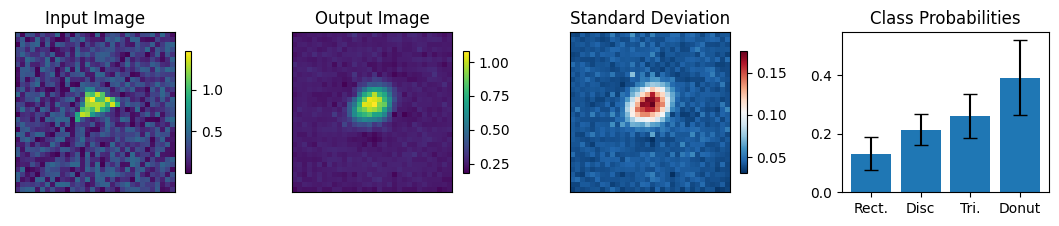
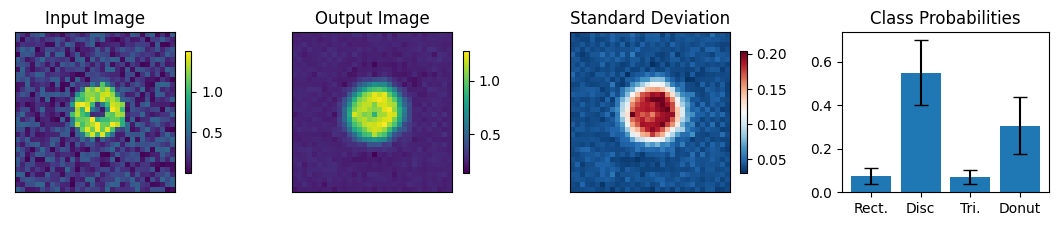
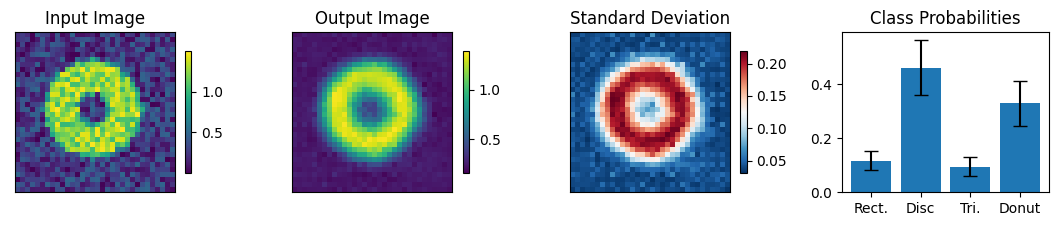
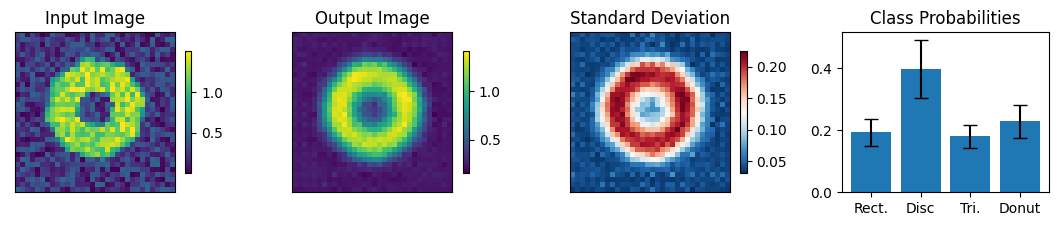
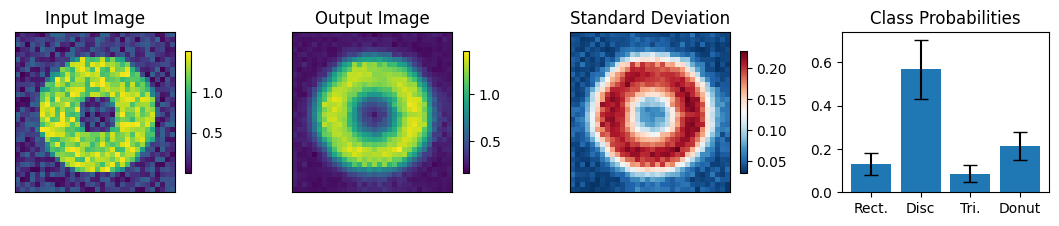
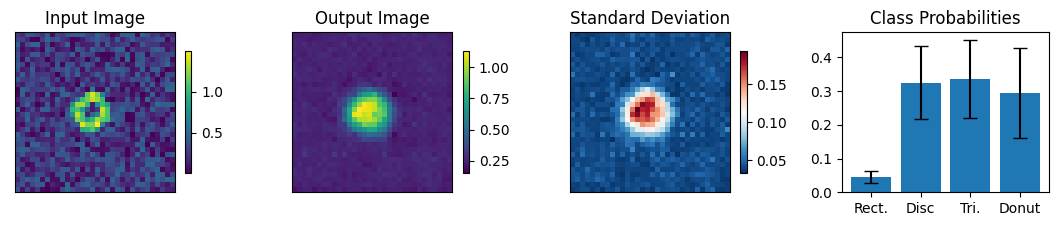
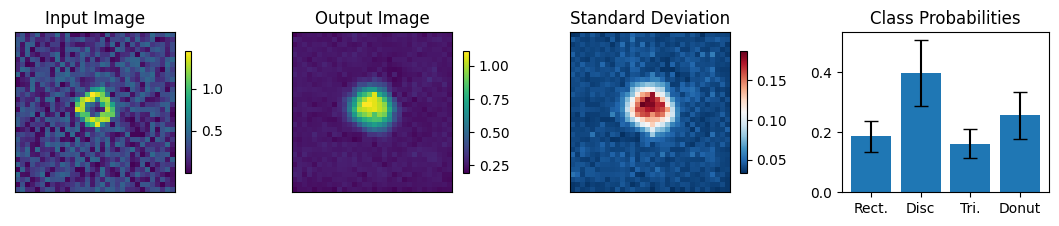
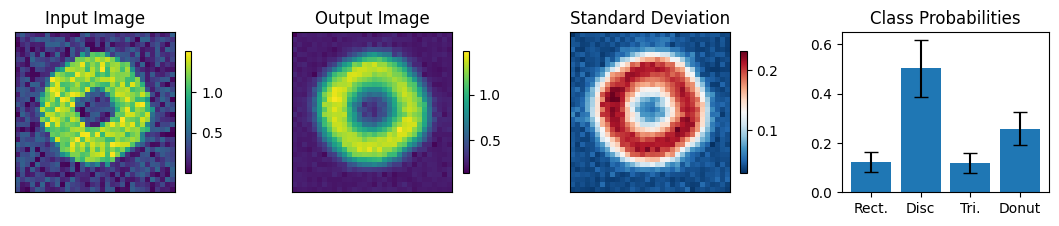
Below we view the network predictions on images previously unseen in the training process. Class probabilities and prediction confidence is shown
[11]:
count = 0
print("--------       The first 10 images encountered     ----------")
for img, simg, p, sp, tlbl, ori in zip(results, sresults, pres, spres, true_lbl, inp_img):
    if count < 10:
        fig = paic.plot_autoencoder_and_label_results_with_std(
            input_img=ori[0].numpy(),
            output_img=img[0].numpy(),
            std_img=simg[0].numpy(),
            p_classification=p.numpy(),
            std_p_classification=sp.numpy(),
            class_names=["Rect.","Disc","Tri.","Donut"])
        plt.show()
        count += 1


print("--------       Incorrectly labeled images  (10 max)   ----------")
count = 0
for img, simg, p, sp, tlbl, ori in zip(results, sresults, pres, spres, true_lbl, inp_img):
    ilbl = np.argmax(p.numpy())
    if int(tlbl) != int(ilbl):
        fig = paic.plot_autoencoder_and_label_results_with_std(
            input_img=ori[0].numpy(),
            output_img=img[0].numpy(),
            std_img=simg[0].numpy(),
            p_classification=p.numpy(),
            std_p_classification=sp.numpy(),
            class_names=["Rect.","Disc","Tri.","Donut"])
        plt.show()
        count += 1
    if count > 10:
        break
-------- The first 10 images encountered ----------
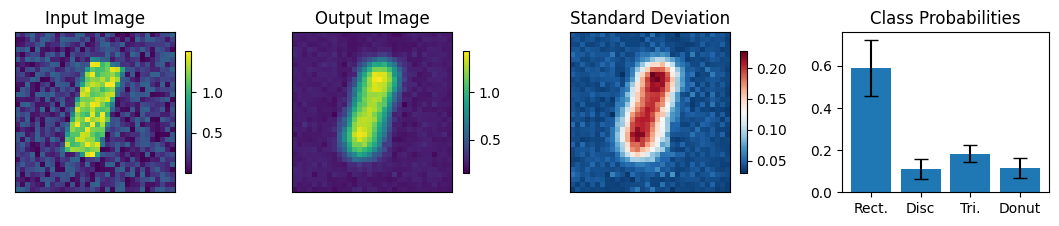
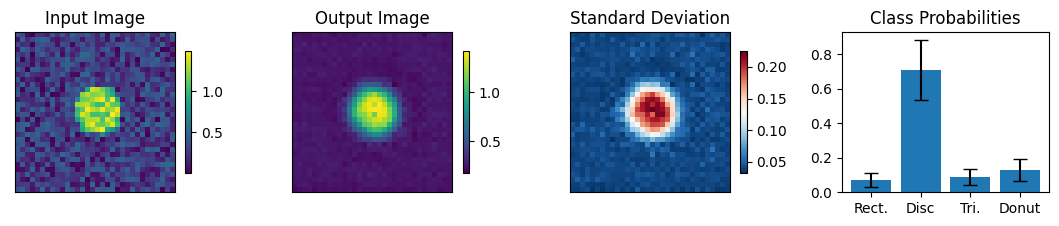
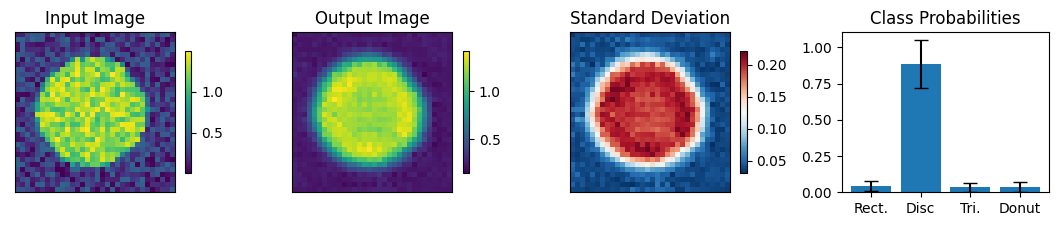
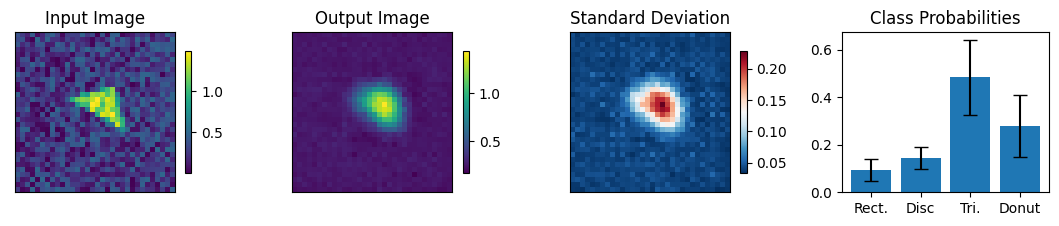
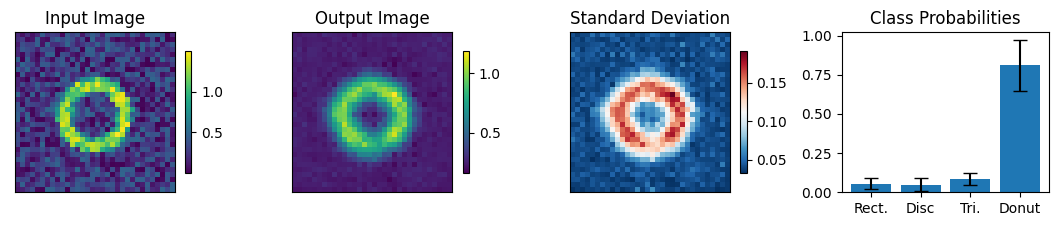
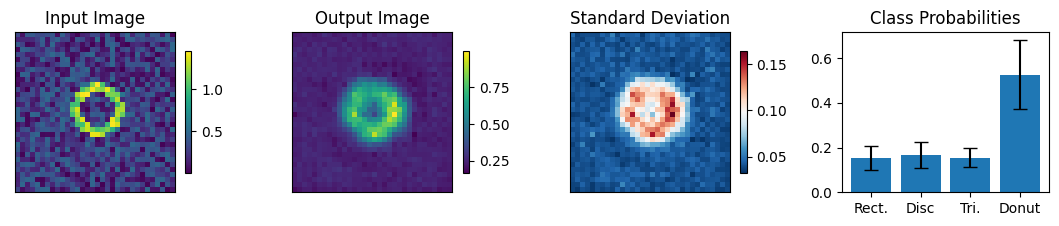
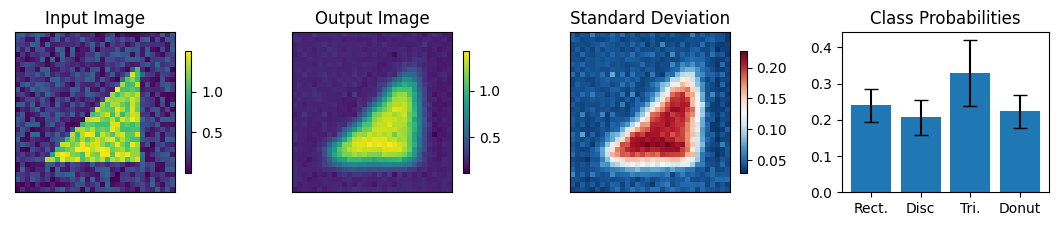
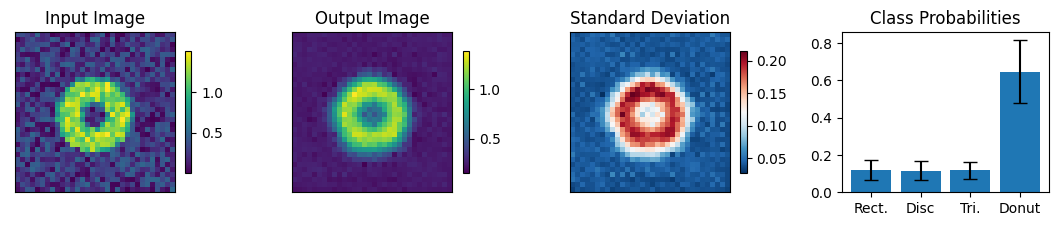
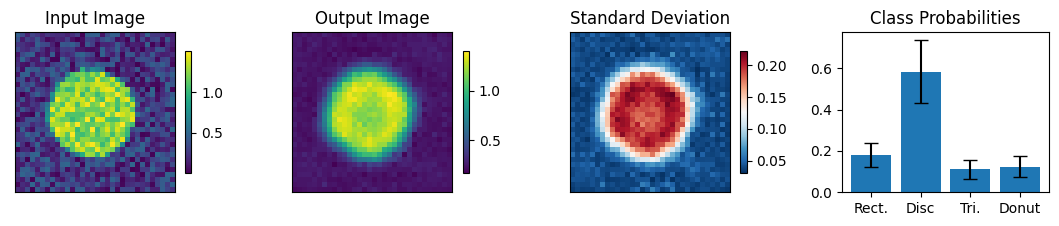
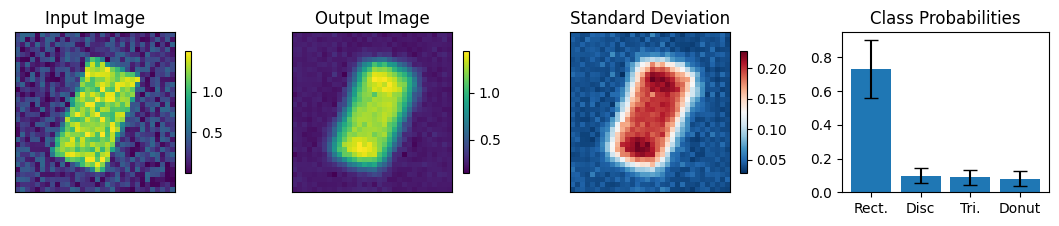
-------- Incorrectly labeled images (10 max) ----------
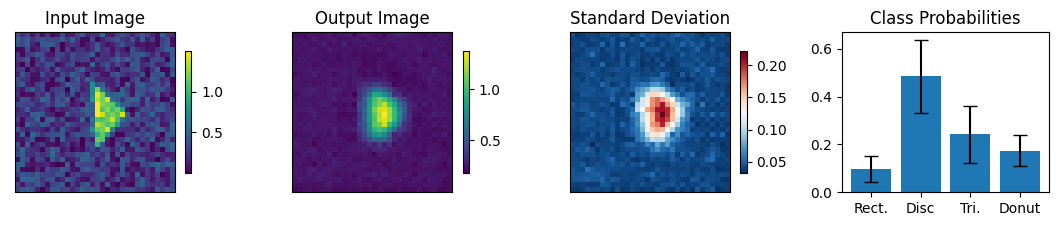
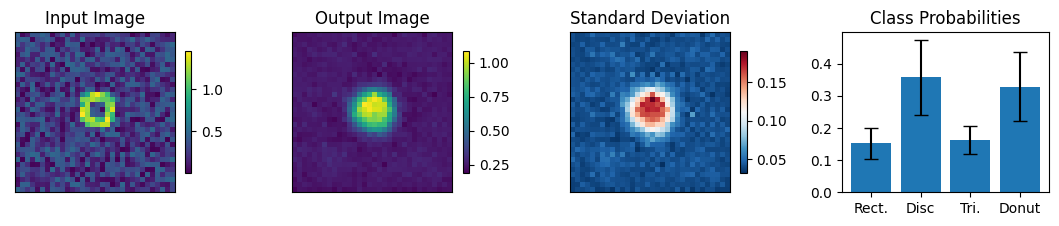
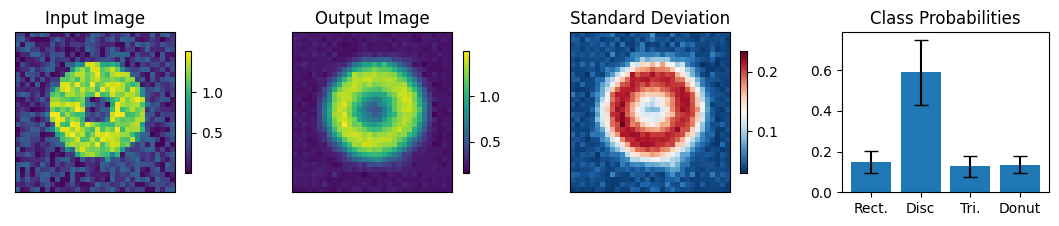
Execution using papermill encountered an exception here and stopped:
[12]:
latent = einops.rearrange(latent, "N C Y X -> N (C Y X)")
umapper = umap.UMAP(min_dist=0, n_neighbors=35)
X = umapper.fit_transform(latent.numpy())
---------------------------------------------------------------------------
TypeError                                 Traceback (most recent call last)
Cell In[12], line 1
----> 1 latent = einops.rearrange(latent, "N C Y X -> N (C Y X)")
      2 umapper = umap.UMAP(min_dist=0, n_neighbors=35)
      3 X = umapper.fit_transform(latent.numpy())

File ~/anaconda3/envs/dlsia/lib/python3.9/site-packages/einops/einops.py:481, in rearrange(tensor, pattern, **axes_lengths)
    479 if isinstance(tensor, list):
    480     if len(tensor) == 0:
--> 481         raise TypeError("Rearrange can't be applied to an empty list")
    482     tensor = get_backend(tensor[0]).stack_on_zeroth_dimension(tensor)
    483 return reduce(cast(Tensor, tensor), pattern, reduction='rearrange', **axes_lengths)

TypeError: Rearrange can't be applied to an empty list
[ ]:
count = 0
for img, cc, tlbl, ori, pl in zip(results, pres, true_lbl, inp_img, infered_labels):
    if int(tlbl[0]) != pl-1:
        paic.plot_autoencoder_and_label_results(input_img=ori.numpy()[0,...],
                                       output_img=img.numpy()[0,...],
                                       p_classification=cc.numpy(),
                                       class_names=["Rectangle","Disc","Triangle","Annulus"])
        plt.show()
        count += 1
    if count > 5:
        break